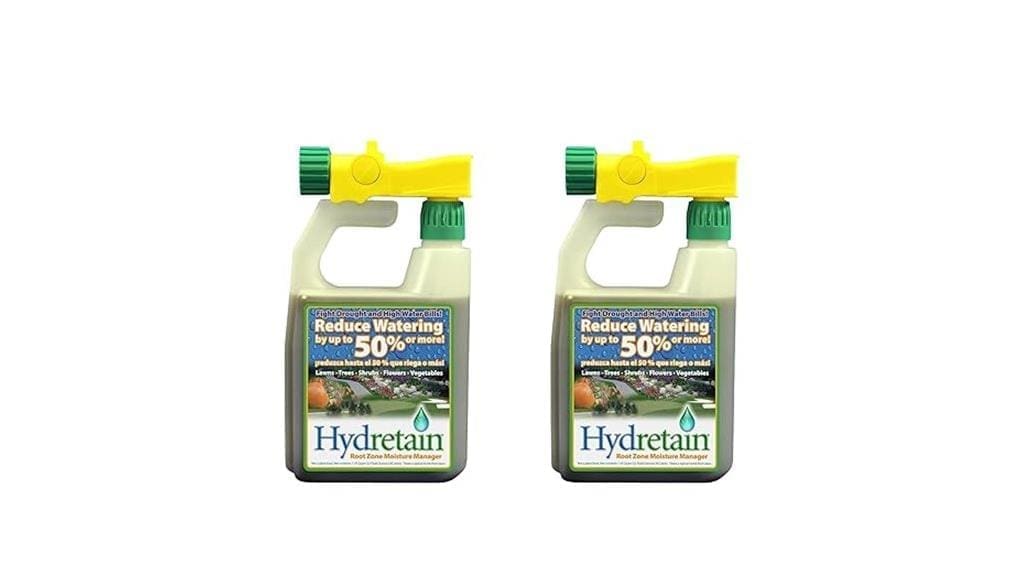

You’ll find Hydretain is a patented humectant that captures soil moisture vapor and condenses it into plant-available water, so you’ll often see longer intervals between irrigations and steadier moisture readings after a single application. Apply 9 fl oz/1,000 sq ft for lawns (followed by ½” irrigation) or 2 fl oz/gal as a drench for containers; expect up to 90 days’ residual action and typical irrigation reductions near 50%. Keep equipment uniform and monitor moisture to confirm savings—more details follow.
Some Key Takeaways
- Hydretain uses a patented humectant to capture soil moisture vapor and condense it into plant-available water at the molecular level.
- A single lawn application (9 fl oz/1,000 sq ft) plus ½-inch irrigation can provide up to 90 days of residual moisture management.
- Field data show 2–3x longer hydration between waterings and measurable improvements in germination, nutrient uptake, and plant vigor.
- Application requires precise dilution and even coverage (hose-end or pump sprayer); gardens use 2 fl oz per gallon as a drench.
- Compared to wetting agents or polymer crystals, Hydretain reclaims vapor, reduces reapplication frequency, and can cut irrigation by up to 50%.
Does Hydretain Root Zone Moisture Manager Really Work?
While no product is a cure-all, Hydretain Root Zone Moisture Manager works by a clear, measurable mechanism: its patented humectant formula captures soil moisture vapor and condenses it into plant-available water at the molecular level, so you get longer-lasting hydration without polymer crystals or surfactant action. You’ll see mechanism validation in reduced irrigation frequency and consistent soil moisture readings after a single treatment. Field data show 2–3x longer hydration between waterings and up to 90 days residual protection, supporting long term efficacy. You’ll join peers who rely on objective metrics to confirm improved germination, nutrient uptake, and plant vigor. This makes it a practical option for homeowners caring for lawns and gardens who value moisture meters to monitor soil conditions.
How to Apply Hydretain for Lawns, Gardens, and Containers
When preparing to apply Hydretain for lawns, gardens, or containers, measure the target area and choose the correct dilution so you deliver the recommended active rate to the root zone; for lawns that’s 9 fl oz per 1,000 sq ft applied via hose‑end or pump sprayer and followed by a ½‑inch irrigation to move product into the root zone, while gardens and containers use 2 fl oz per gallon as a drench to saturate the root zone. You’ll select application equipment that guarantees even distribution, plan timing windows for cooler parts of day, and label mixes. Apply uniformly, avoid overlap, and record dates. For best results, consider integrating Hydretain use with smart irrigation scheduling to optimize water delivery and promote efficient water use.
What Coverage, Duration, and Water Savings to Expect?
For planning purposes, expect each 32 fl oz bottle in the two‑pack to contribute toward treating roughly 10,000 sq ft (the full 64 fl oz covers about 20,000 sq ft) with a single application that provides up to 90 days of residual root‑zone moisture management when applied at the recommended 9 fl oz/1,000 sq ft and irrigated in; in practice you can typically reduce irrigation volume or frequency by as much as 50%, though exact savings depend on soil type, turf species, climate, and irrigation scheduling. Use these coverage estimates to map applications; one treatment replaces monthly wetting agents. Track irrigation scheduling and soil moisture to validate savings. These estimates are useful when selecting watering systems and accessories like hose timers to optimize your lawn care routine.
Pros, Cons, and Real-World User Scenarios
Because Hydretain pulls vapor into the root zone rather than just improving wetting, you’ll see clear benefits for drought-prone sites and high-value turf—longer intervals between irrigations, more consistent seed germination, and improved plant vigor with a single application lasting up to 90 days. You’ll gain drought resilience and reduced irrigation costs, though cost considerations include initial product price and proper application equipment. Pros: extended moisture retention, broad compatibility, 90-day residual. Cons: upfront cost, need for precise dilution/application, limited instant effect for severely dry profiles. User testimonials report turf recovery and water savings; environmental impact is lower water use and reduced runoff. Many homeowners pair moisture-management products with complementary lawn and landscape tools to maintain healthy outdoor spaces.
How Hydretain Compares to Wetting Agents, Surfactants, and Polymer Crystals
Having covered real-world benefits and trade-offs, let’s compare Hydretain’s moisture-capturing mechanism directly with wetting agents, surfactants, and polymer crystals. You’ll see Hydretain uses molecular condensation and vapor capture to convert soil vapor into plant-usable droplets at the root zone. Wetting agents and surfactants reduce surface tension to improve water penetration but don’t reclaim vapor, so they need frequent reapplication. Polymer crystals store liquid like a sponge but can alter soil structure and require recharging. Hydretain delivers residual action up to 90 days, lowering watering frequency and integrating with professional and home routines without replacing standard soil conditioners. This comparison is especially useful for home gardeners selecting irrigation products for drip irrigation systems.
Some Questions Answered
Is Hydretain Safe for Pets and Children After Application?
Yes — when you apply Hydretain as directed, pet exposure is minimized and treated areas are safe once surfaces dry after irrigation. You should follow application timing: apply, then water in per label and keep pets and children off treated areas until dry. You’ll protect family and animals by storing product securely, using recommended dilutions, and avoiding accidental ingestion. Contact poison control or manufacturer for any exposure concerns.
Can Hydretain Be Mixed With Fertilizers or Pesticides?
Yes — you can tank-mix Hydretain with many fertilizers or pesticides, but you should perform compatibility testing first. You’ll mix small trial batches, check for precipitation, separation, or pH shifts. Respect application timing: apply Hydretain and irrigate per label, then add other products only if tests pass and timing won’t reduce efficacy. Follow label instructions, consult manufacturers when unsure, and join local applicator groups for shared practical guidance.
Does Hydretain Affect Soil pH or Microbial Activity?
No, it doesn’t markedly alter soil chemistry or disrupt microbial dynamics when used as directed. You’ll convert vapor to plant-available water without changing pH or major nutrient balances; studies and product design target moisture redistribution, not chemical modification. Microbial communities benefit from steadier moisture—so you’ll often see improved biological activity and nutrient cycling. Follow label rates and irrigation to maintain balance and guarantee compatible, community-minded stewardship of your soil.
Is Hydretain Effective in Clay-Heavy or Saline Soils?
Yes — you’ll see benefits in clay-heavy and saline soils. Hydretain’s humectant-driven mechanism improves clay mitigation by converting vapor to liquid in compacted root zones, enhancing water availability and reducing surface runoff. For saline tolerance, it helps plants access existing moisture despite salts but won’t remove salts; combine with leaching irrigations and soil amendments. Apply as directed, monitor salinity, and your planting community will thrive with improved moisture resilience.
Can Hydretain Be Used on Newly Planted Sod or Seedlings?
Yes — you can use Hydretain on newly planted sod and seedlings. For establishment timing, apply at planting following label rates (dilute for seedlings, drench sod root zone) and irrigate to move product into soil. It supports seed germination by retaining vapor-phase moisture and reducing watering frequency, aiding uniform emergence and root establishment. You’ll feel included in professionals using it for quicker, more resilient establishment under constrained water schedules.


