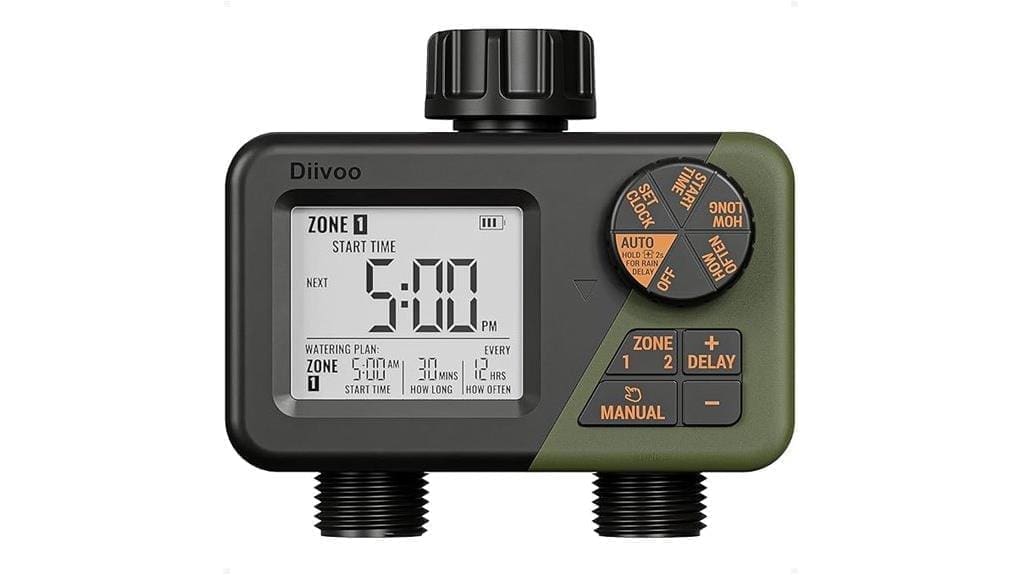
You’ll get a simple, battery‑powered two‑zone timer that runs independent schedules, manual spot watering, and a forecast‑based rain delay for 1–7 days. You’ll program start times, durations up to 240 minutes, and frequencies including hourly intervals, specific days, or even/odd days. Installation mounts to a faucet with included washer and tape; connectors handle common hose sizes. It’s rugged and waterproof for garden use but not expandable or sensor‑ready—more details follow if you want them.
Some Key Takeaways
- Controls two independent outlets with separate start times, durations (0–240 min), and frequencies for flexible backyard watering.
- Manual mode and two independent start times allow spot watering and basic staggered schedules without reprogramming presets.
- Rain delay uses local forecast to pause irrigation for 1–7 days, reducing overwatering during wet periods.
- Battery‑powered (2×AA) with ~6–8 month life, IPX5 waterproofing, and reinforced nylon connectors for typical garden pressures.
- Limited to two zones, no external sensor or Wi‑Fi support; consider multi‑zone smart controllers for larger or remote‑managed systems.
What the Diivoo Sprinkler Timer 2 Zone Actually Does and Who It’s Best For
Control your watering schedule for two separate areas with the Diivoo Sprinkler Timer 2 Zone: it runs two independent outlets so you can program different start times, durations (0–240 minutes) and frequencies (from hourly intervals to specific days, even/odd days, or daily), use a manual mode for temporary watering without altering presets, and pause irrigation with a 1–7 day rain delay based on forecast data. You’ll manage microzones like lawn and planter beds independently. It’s ideal if you want practical, community-minded irrigation tools that support emerging watering analytics and optional voice control integrations. Expect reliable, durable operation for routine landscape needs. It’s a solid fit for homeowners who care for their outdoor spaces and need simple, effective sprinkler supplies to enhance their backyard oasis.
How to Install and Program Both Zones (Step‑by‑Step)
Now that you know what the Diivoo 2‑zone unit can do, let’s get both zones working. Mount unit to a stable faucet, use included sealing washer and thread‑seal tape, then fit 1/2″ quick connectors or adapt to 3/4″. Insert 2×AA batteries, power on. Program Zone 1: set start time, duration (0–240 min), frequency; repeat for Zone 2. Test each zone in manual mode, watch for leaks. Use flow calibration if you have a flow meter—adjust durations to match coverage. If a valve won’t open, consult installation troubleshooting: check battery polarity, connector seating, and filter obstruction. For homeowners looking to maintain a lush lawn, consider seasonal adjustments and watering schedules to match plant needs.
Real‑World Performance: Scheduling, Manual Mode, Rain Delay, Battery Life
Although the Diivoo handles basic schedules reliably, you’ll want to understand its limits when planning irrigation: you can set two independent start times with durations from 0–240 minutes and frequencies from hourly increments up to every-7-days (including even/odd day options), but complex staggered cycles or overlapping runs require manual coordination. In real use you’ll find manual mode handy for spot watering without disturbing programs, and rain delay suspends runs 1–7 days based on local forecast. Battery life typically lasts 6–8 months; plan for timely battery replacement. User feedback praises simplicity but notes planning constraints for larger, zoned systems. This makes the Diivoo a solid option for homeowners who want simple automated care for their yards and gardens, especially those focused on backyard watering and easy-to-use timers.
Durability and Leak Protection: Materials, Waterproofing, and Build Quality
While the Diivoo’s rugged components don’t make it indestructible, they do address the failure points you care about: connectors are molded from 30% reinforced nylon to withstand typical garden pressures (7.25–116.03 psi), and the included aluminium-alloy filter, sealing washer and thread‑seal tape cut down common leak sources at joints. You’ll appreciate reinforced connectors and tight fittings during seasonal use. IPX5 waterproofing, a sealed battery compartment and resilient buttons resist spray and brief submersible testing to 15 cm for 24 hours. Build quality targets long service life; maintenance is straightforward—check seals and replace thread tape when swapping hoses. Keep rainwater away from your outdoor living areas with downspout extensions to prevent pooling around irrigation connections.
Should You Buy It? Pros, Cons, and Best Alternatives to Consider
If you need a straightforward, budget-friendly controller for two separate watering zones, the Diivoo delivers the core features you’ll use—independent schedules, flexible durations up to 240 minutes, manual and rain‑delay modes—while its reinforced connectors, seal kit and IPX5 protection reduce common leak and weather failure points. You’ll buy it if you want reliable, low-cost irrigation that fits standard hoses, prioritizes water conservation, and integrates informally into a smart home via routine automation. Downsides: no external sensor, battery-only power, limited expansion beyond two zones. Consider multi-zone Wi‑Fi controllers or sensor-ready valves if you need scalability or remote app control. This product is aimed at homeowners who enjoy maintaining their outdoor spaces and need simple, effective irrigation for yards and gardens with oscillating sprinklers outdoor spaces.
Some Questions Answered
Does It Support Smartphone or Wi‑Fi Control?
No — it doesn’t support smartphone integration or cloud control. You’ll operate it locally via buttons and its screen; there’s no Wi‑Fi, app, or remote cloud access. That keeps setup simple and reliable for on‑site irrigation management. You can still program independent 2‑zone schedules, manual runs, and rain delays, but plan to be physically present to change settings. This suits users who prefer direct, dependable control without app dependencies.
Can I Link Multiple Units for More Than Two Zones?
No, you can’t link multiple units into a single controller — each unit runs independently, so expandability options are limited to adding separate timers for extra zones. You can, however, coordinate schedules manually across devices. Check wiring compatibility if you plan to use shared valves or a central manifold: connectors and quick-hose fittings are standard, but there’s no electrical daisy-chaining or Wi‑Fi integration for unified multi-unit control.
Is There a Child Lock or Keypad Lock Feature?
No — it doesn’t include a dedicated child lock or keypad security feature. You’ll rely on placement and physical protection to guarantee child safety. For irrigation systems, secure mounting, elevated installation, or an external lockable box will prevent accidental changes. Keep batteries and controls out of reach and clearly label controls so everyone in your group knows not to tamper. These practical steps maintain keypad security and safe operation for your shared watering setup.
Are Replacement Seals and Filters Sold Separately?
Yes — replacement parts like seals and filters are sold separately. You can buy replacement parts (sealing washer and aluminium-alloy filter) if the original wear out. Verify seal materials match the supplied 30% reinforced nylon connectors and sealing washer spec to guarantee proper pressure tolerance and leak protection. Order from authorized retailers or the manufacturer to maintain compatibility. Community members recommend keeping spare seal materials on hand for quick field repairs.
Does It Work With Drip Irrigation Systems?
Yes — you can use it with drip irrigation, but you’ll need to manage water pressure and emitter clogging. You’ll set short durations and frequent cycles to mimic drip schedules, use the aluminium-alloy filter and regular flushing to reduce clogging, and avoid pressures above the connector’s range. You’ll also monitor batteries to keep valves responsive. Join other growers who tune pressure and maintenance for reliable zone-by-zone drip performance.