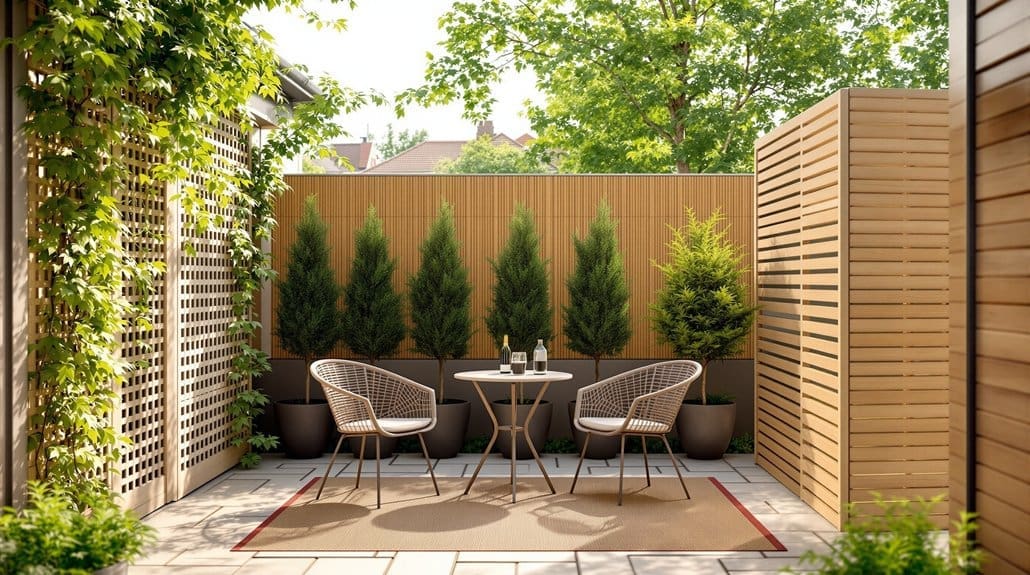
Privacy Planning: Screening Options for Your Patio — You’ve got lots of choices, and you can start small. Roll‑up bamboo or vinyl shades and freestanding planter trellises are cheap, fast, and renter‑friendly, while solid or slatted wood and vinyl panels give more permanence at higher cost and upkeep tradeoffs. Planting evergreens or fast Thuja hedges buys long‑term cover but needs spacing and regular trimming. Pergolas or tall panels add height and shelter, and you can mix solutions as you go to improve over time, keep going to learn more.
Some Key Takeaways
- Choose material by balancing cost, permanence, and upkeep: roll-up shades for cheap/temporary, wood/metal for long-term investment.
- Match solid vs. slatted screening to needs: solid for maximum privacy and noise control, slatted for light and airflow.
- Use fast-growing evergreens (Thuja ‘Green Giant’) or hedges for living screens, spaced and pruned for access and airflow.
- Employ trellises, planter-mounted lattices, or freestanding panels when attachment isn’t possible or for renter-friendly solutions.
- Factor wind, local height rules, and maintenance frequency when selecting screens and planning installation.
Compare Patio Privacy Options at a Glance: Cost, Permanence, and Upkeep
If you’re trying to figure out what will work for your patio, start by thinking about how long you want the solution to last and how much time you’ll spend on it—because cost, permanence, and upkeep are all tied together. Quick wins like roll-up rattan shades or trellis planters cost little, install fast, and ask almost no care—great if you’re renting or testing a spot. Vinyl Privacy Screens and prebuilt polyethylene panels sit in the middle: moderate price, weather-ready, and only need an occasional wash. A living Privacy Fence of Thuja hedges starts cheaper per plant, grows into something lasting, but needs water and pruning early on. For a more finished look, wood or metal screens cost more and demand periodic upkeep, but they age like furniture. We also sell a range of stylish pergola kits that make adding structure and shade to your patio simple and attractive; see our pergola kits for options.
Solid Fences Vs. Slatted Fences: Tradeoffs for Light, Airflow, and Seclusion
When you’re weighing solid versus slatted fences, think about what matters most to you day-to-day — complete seclusion and noise reduction, or light, breezes, and fewer damp corners — because each choice changes how your patio feels and functions. Solid privacy fences give you real shelter, they block sightlines and tame sound, but they can cut daylight, slow airflow, and create wetter spots you’ll need to manage. Slatted or horizontal wood fences, with narrow or staggered gaps, let in sun and cross‑breezes while still hiding sitting‑height views, and perforated or louvered versions tune sightlines without closing you off. Consider local height rules, material longevity, and your microclimate, then pick spacing and orientation that favors comfort over perfection. Stylish wind screens can help blend function with design and protect your outdoor living area while enhancing curb appeal, so explore wind screens as a finishing touch.
Evergreens and Hedges for Year-Round Screening: Speed, Spacing, and Maintenance
Plant your evergreens with purpose—space faster growers like Green Giant or Leyland cypress about 4–6 feet apart to close gaps quickly, and aim for 6–8 feet if you want a more mature, seamless screen down the road. Give them 2–3 feet of clearance from fences so you can prune, water deeply while they establish, and mulch to keep roots happy; annual light pruning in late winter keeps the hedge dense without killing vigor. It won’t be perfect overnight, but with steady care—regular watering the first 2–3 years, yearly trims, and skipping heavy shearing—you’ll get reliable year‑round privacy, faster than you think. Consider installing wooden planters to contain roots and create tidy, movable screens for patios with limited planting space, since wooden planters protect roots while enhancing outdoor living areas.
Planting Distance And Spacing
Spacing your evergreens thoughtfully will save you headaches down the road, because the right distance decides whether you get a dense, quick screen or a crowded mess that needs constant fixing. Plant Thuja ‘Green Giant’ about 6–8 feet on center for fast, near-seamless screening, and if you prefer formal, slow-growing hedges like boxwood, space them tighter, 2–4 feet, knowing they’ll take longer to reach privacy height. Use larger trees, such as Leyland cypress, at 8–12 feet apart to avoid future root and branch fights. Stagger two rows or mix tall evergreens with mid-level shrubs to close gaps faster while keeping airflow, and remember watering the first few seasons matters more than perfect spacing. Progress over perfection. Consider using interlocking pavers to define planting beds and protect root zones while creating cohesive patio edges with pavers and planting.
Pruning Frequency And Care
Pruning keeps your screen doing its job without turning your yard into a jungle, and since you’ve already figured out spacing, the next job is learning how often to trim and how hard to cut. Heading: When to prune. For fast growers like Thuja ‘Green Giant, pruning frequency is light twice a year, spring and mid-summer, with formative cuts in the first 2–3 years to build tight columns. Keep a taper, trim annually so lower foliage gets light, and don’t remove more than one-third of live growth at once. Use sharp tools, ease up in drought or winter, and water well while established. Action step: aim for steady, small trims over occasional heavy hacks. Progress beats perfection. You’ve got this. Consider combining evergreen screens with durable composite decking to create a low-maintenance, cohesive outdoor living space.
Trellises and Climbers: Cheap Vertical Coverage That Softens Hard Edges
Trellises are one of the fastest ways you can add vertical coverage—buy a budget panel or two, stagger them, and you’ve got an instant frame for climbers. Plant quick growers like clematis, honeysuckle, or jasmine in deep containers or raised beds so roots stay happy, and pick vinyl or ventilated panels if you want low fuss and airflow. You’ll prune and tie a bit the first couple seasons, but with simple supports and steady care you’ll trade hard edges for green privacy before you know it. Many homeowners use trellis panels to create charming outdoor rooms and define patio spaces with decorative trellis ideas.
Fast-Installing Trellis Panels
Get a quick win by installing a ready-made trellis panel, which lets you add instant height and privacy without a full build—screw a lightweight vinyl panel to a deck railing, pop a no-dig sleeve into soggy ground, or mount one to concrete with surface brackets, and you’ll have a clean, vertical screen in an afternoon. Privacy Screen Ideas: choose Pre-built trellis panels sized to your need, from budget options at big-box stores to sturdier no-dig kits for tricky soil. Pick anchoring that matches your surface—post sleeves for a deck, surface brackets for concrete, no-dig sleeves for wet yards—so the panel stays put in wind. Vinyl panels need little care, and you can train vines later for softer, lived-in privacy. Progress over perfection. Stylish outdoor products can help homeowners easily personalize their patio with cohesive screening options, stylish privacy screens that complement existing decor.
Best Climbing Plants
Choosing the right climber can transform a plain trellis into a living screen fast, and you don’t have to be a green-thumb expert to get good results. Best climbing plants: start with fast-growing evergreen climbers like English ivy or climbing euonymus, they give dense coverage in 1–3 years and handle shade, so you’ll feel sheltered sooner. If you want blooms, honeysuckle rockets up 10–20 ft a year and clematis fills in with 6–12 ft of color, bringing neighbors together over shared scent. Star jasmine adds refined, semi-evergreen charm and strong fragrance in mild climates. Try morning glory or sweet pea for one-season trials, they’re cheap and teach you sightlines. Plant smartly, expect light pruning, and celebrate progress. Consider adding a sturdy plant stand to display pots and encourage vertical growth on your patio.
Maintenance And Support
Planning maintenance and support for a trellis and climbers is mostly about setting yourself up to spend a little time each season, not getting trapped in endless chores. Maintenance and Support: pick weather-resistant Trellises, cedar or vinyl if you want low fuss, mount panels to a fence or go freestanding, and space supports 6–8 feet for vigorous growth. Actionable steps: train Fast-climbing vines like clematis, honeysuckle, or roses during establishment, prune lightly, and fertilize seasonally to keep density without chaos. For tight or wet spots, use narrow panels or container-grown climbers in raised planters so roots stay healthy and movable. Progress over perfection: check ties and panels annually, fix issues early, enjoy the privacy you’ve built together.
Lattice, Vinyl Panels, and Plastic Screens: Low‑Maintenance Privacy You Can Buy Now
A good low‑maintenance screen can change your patio from exposed to cozy without turning the project into a weekend obsession, and vinyl, lattice, or plastic panels are the kind of quick wins you’ll appreciate later. Heading into privacy, vinyl panels like Acurio’s lattice give you clean white panels that won’t need painting, so you and your neighbors can relax sooner. You can buy taller Enclo panels that resist pests, or KOZYARD‑style polyethylene pieces that mimic wood grain, shrug off water, and hide bins or A/C units. Want cheaper? BrylaneHome trellis sets pair with vines, they’re light and forgiving. Install is usually simple, sizes match common fence heights, and mixing panels helps you build privacy step by step. Progress beats perfection.
Freestanding Screens and Panels (Portable Solutions for Renters)
Freestanding screens are the renter-friendly shortcut that lets you carve out privacy without drilling holes or begging for permission, and they come in styles that mimic fences, trellises, or full-on room dividers so you can pick what fits your space and budget. Think portable solutions that make backyard privacy feel possible, you’ll find vinyl lattice panels that resist pests and need no painting, lightweight trellis sets you can lean or tie to railings for quick green coverage, and taller wood or metal framed screens that sit in weighted bases for stability. Expandable accordion panels adjust for odd edges, and planter-top lattices give living screening plus mobility. Start small, layer pieces, and tweak until it feels like yours.
Pergolas, Roofs, and Fixed Structures: Adding Height and Permanent Shelter
Pergolas give you height and structure, so you can add privacy panels, built-in screens, or even an integrated green wall that softens the look while blocking sightlines. You can cap a pergola with a fixed roof and lattice to keep out rain and noses, or attach a 2–3 foot lattice to existing fence posts to reach eye‑blocking height without rebuilding the whole barrier. Just remember these are permanent changes—they often need footings and sometimes permits—so plan for local rules, start small, and improve as you go.
Pergola With Privacy Panels
Think of your backyard as an extra room, and you’ll see why fitting a pergola with tall privacy panels can change how you use it — you’ll shut out street-level views while keeping breezes and daylight, and you can make the privacy as permanent or flexible as you like. Heading into design, pick a pergola with privacy panels that match your style — Wood Slat feels warm and modern, laser-cut screens are decorative, and vinyl works for low upkeep. Aim for 6–8 ft panels to block first-floor sightlines, follow local height rules, and choose rot-resistant materials. Add retractable curtains or roll-down blinds for adjustability, or plant climbers in attached boxes for a living screen. Progress over perfection — let it grow.
Fixed Roof With Lattice
Adding a fixed lattice roof can turn a plain patio into a sheltered, private nook without cutting off the breeze or daylight, and you’ll find it’s one of the simplest ways to raise your privacy profile—literally. How it helps: a fixed roof with lattice, built with 1x2 or 1x3 slats spaced 2–4 inches, filters light and keeps airflow, while a 6 ft tall extension beats standard fence sightlines when paired with plants or trellis panels. Pick rot‑resistant materials, like FSC wood or vinyl lattice panels, attach them to sturdy posts with galvanized hardware, and consider planter boxes for climbing vines—privacy ideas that grow stronger in 1–2 seasons. Check local height limits and permits before you build. Progress, not perfection.
Integrated Green Wall System
When you want real, lasting privacy that also feels alive, think of a pergola or fixed roof as the backbone for an integrated green wall system—you get shade and structure, and vines or modular panels do the rest, softening views and roughly doubling the sense of seclusion compared with a standard 6‑ft fence.
Plan to Create Privacy by sizing pergolas 8–10 ft high, using 4x4 or 6x6 posts with proper footings so attached planters and trellis won’t pull the structure down, and combine fixed louvered screens with climbing clematis or honeysuckle for immediate cover. Choose modular living-wall panels with built-in irrigation and lightweight media, keep panels under 50–75 lb, and check local height rules—detachable pieces help you stay legal while you grow in.
Mixed Approaches: Layering Plants, Fences, and Panels for Depth and Resilience
If you want privacy that feels solid but also lived-in and flexible, layering fences, plants, and panels gives you the best of all worlds—immediate coverage from a 6-foot fence, faster-growing evergreens like Thuja ‘Green Giant’ to add height in a few seasons, and movable pieces like planters or freestanding screens to soften or shift sightlines as needed. Heading: Mixed Approaches. You can add privacy by combining a 6-ft fence with Thuja planted 3–4 ft out, spacing 6–8 ft, for quick evergreen height, then top older fence sections with lattice or vinyl panels to gain a few feet without permits. Place raised box planters with shrubs or vines to soften lines, or use freestanding screens to block specific views. Layering plants builds depth, seasonal interest, and resilience. Progress beats perfection.
Quick DIY and Budget Options: Containers, Bamboo Rolls, and Thrifted Panels
Mixed approaches work great, but you don't always need a big project to get usable privacy fast — small, cheap fixes can buy you breathing room while plants do their thing. Quick wins: drop tall containers (24–36 in. pots) with Thuja or clumping bamboo along edges to make a 6–8 ft outdoor living screen without digging, it’s instant and moveable. Clip bamboo roll-up screens to an existing fence with zip ties or screws, they run about $20–$60 and look natural. Thrifted or IKEA panels mounted on posts or planters create modular privacy for $30–$150, and you can change layout anytime. For portability, hang a heavy-duty roll-up curtain on hooks, cheap and snooze-proof. Progress over perfection; try one thing, adjust.
How to Choose the Right Screen for Your Patio: Site, Style, Code, and Timeline
Before you pick a panel or plant, take a breath and walk the space like you’re sketching a plan — note where the sun hits during your favorite hours, how the wind gusts through, and which sightlines you actually want blocked versus those you don’t care about. Site matters: measure sun, wind, and views when you use the outdoor space, check zoning and HOA rules, and see if permits are needed. Style and material follow function — rot‑resistant vinyl for wet spots, FSC wood for a warm look, or layered evergreens plus a short trellis for taller privacy. Think timeline and upkeep: instant panels cost more, live hedges take time and trimming. If attachment’s impossible, pick freestanding or planter‑mounted screens. Progress over perfection.
Some Questions Answered
Can Screening Increase My Property Resale Value?
Yes — screening can boost resale value, by improving curb appeal and matching buyer preferences, which lifts marketability metrics in many neighborhoods. Picture a cozy, private patio, buyers nodding, imagining gatherings — that emotional pull matters. Start with tasteful, durable materials, follow neighborhood trends so it feels right, and don't overbuild. Small, well-done upgrades show care, add usable space, and often tip offers in your favor. Progress beats perfection.
Will Neighbors Legally Challenge My Taller Screens?
Yes, neighbors can challenge taller screens, but it depends on zoning setbacks and any privacy easement that applies to your property. Start by checking local setback rules, talk with your neighbors early, and review deeds for easements, so you avoid surprises. If someone objects, you can often negotiate a compromise, adjust height, or get a permit. Progress over perfection—small changes and clear communication usually keep things friendly.
How Do I Prevent Roots From Damaging Nearby Foundations?
Start by choosing trees with non-invasive roots, and place them far enough from foundations so roots won’t reach, you’ll reduce risk. Install root barriers where roots could head toward a wall, they redirect growth downward. Keep watering and mulch away from foundations, roots follow moisture. Check growth yearly, prune or replace if a species starts crowding. Progress over perfection—small steps now save big repairs later, you’ve got this.
Can Screening Reduce Mosquitoes and Other Pests?
Yes — screening can cut mosquitoes and other pests, because it creates a physical barrier that interrupts mosquito behavior and aids pest exclusion. Picture a tight-knit screen, snug in frames, keeping bugs out while you relax, because they can’t find the air gap they seek. Install fine mesh, seal edges, reduce standing water nearby, and add door sweeps, and you’ll notice fewer bites, more evenings outside. Progress, not perfection.
Are Any Screening Materials Recyclable or Eco-Friendly?
Yes — some screening materials can be recyclable or eco-friendly. You can choose recycled aluminum frames, which cut energy use and keep metal out of landfill, and biodegradable mesh options for seasonal screens, which break down more gently if composted. Start with durable recycled frames, pair them with biodegradable mesh where wear is likely, and replace bits as needed. It’s not perfect, but small choices add up.