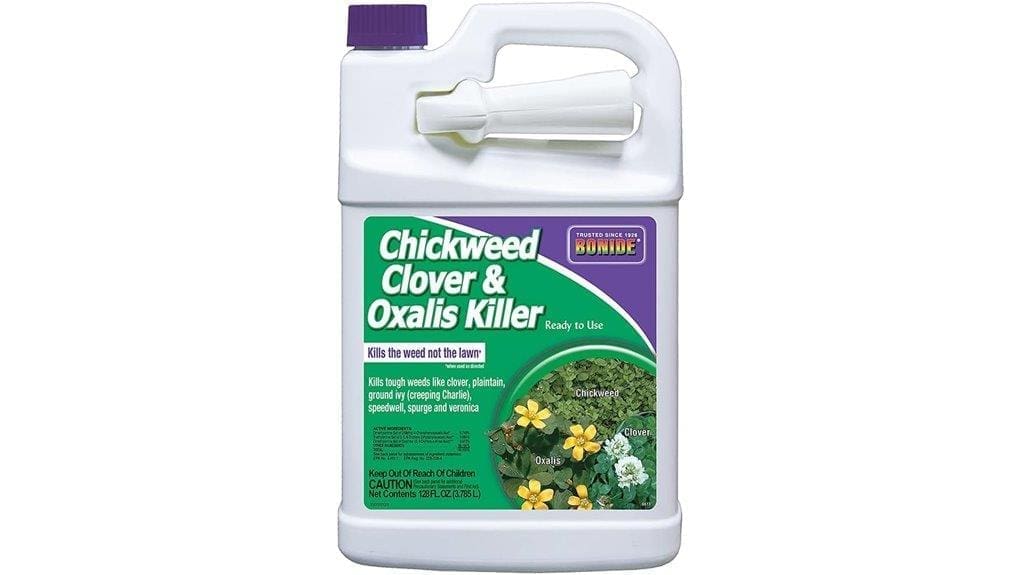
You’ll get a ready-to-use systemic herbicide containing dicamba and triclopyr that penetrates foliage and translocates to roots, showing necrosis in 24–48 hours and substantial dieback in 7–21 days. It reliably controls chickweed, clover, and oxalis when applied with the handheld 128 fl oz sprayer across up to 10,000 sq ft, though tougher species and stressed turf respond slower and repeat treatments may be needed. Keep off treated areas until dry and follow label precautions, and more details follow.
Some Key Takeaways
- Ready-to-use systemic herbicide (dicamba + triclopyr) effectively controls chickweed, clover, and oxalis.
- 128 fl oz sprayer covers up to 10,000 sq ft with handheld trigger for uniform application.
- Visible necrosis in 24–48 hours; full dieback typically in 7–21 days under normal conditions.
- Performance can be patchy on stressed or thin turf; repeat treatments and proper timing may be needed.
- Requires PPE, drift precautions, and avoidance near desirable broadleaf plants and newly seeded lawns.
How Bonide Chickweed, Clover & Oxalis Killer Works and What’s Inside
Although it looks like a simple spray, Bonide Chickweed, Clover & Oxalis Killer relies on a systemic herbicide blend—dicamba and triclopyr—formulated in a ready-to-use liquid to penetrate foliage, translocate through the plant, and kill roots. You’ll use standard application equipment—handheld trigger sprayer attached to the 128 oz bottle—so spray coverage is uniform. The technical label guides rates, timing, and safety measures; you’ll follow PPE and buffer-zone instructions. Expect rapid translocation and root mortality while you consider environmental impact: avoid drift, protect desirable plants, and respect runoff controls. You belong to a careful, informed user community. Choose a pre-emergent when appropriate to prevent weeds before they sprout and complement post-emergent controls with integrated lawn care.
Real-World Performance: Does It Kill Chickweed, Clover, Oxalis and Other Weeds?
Cutting through marketing claims, Bonide Chickweed, Clover & Oxalis Killer delivers consistent, systemic control of broadleaf turf weeds—dicamba and triclopyr translocate from leaves to roots, producing visible necrosis within 24–48 hours and substantial dieback over 7–21 days under normal conditions. You’ll see reliable mortality on chickweed, clover and oxalis in varied lawns; tougher species like ground ivy and wild violet respond more slowly but show significant decline. Success depends on correct application timing and turf health; integrate cultural practices and herbicide rotation for resistance management. Expect patchy results on stressed turf—repeat treatment and monitoring guarantee thorough control. Homeowners who enjoy their outdoor spaces should also combine treatments with lawn care practices to protect and maintain healthy turf.
How to Use the 128 Oz Ready-To-Use Spray for up to 10,000 Sq Ft
When used as directed, the 128 fl oz ready-to-use Bonide spray delivers up to 10,000 sq ft of broadleaf weed control by allowing you to make multiple, evenly distributed passes without mixing or measuring; each application deposits a systemic dicamba/triclopyr formulation that translocates to roots for rapid necrosis and lasting control. You’ll plan coverage by mapping zones and walking uniform swaths to avoid overlap. Observe application timing—treat active growth for uptake and avoid extremes. Set nozzle adjustment for a coarse spray to minimize drift and maximize deposition on foliage. Maintain consistent speed, inspect nozzles, and store the unit upright between uses. For best results on home lawns, choose selective herbicides designed for lawns and landscape beds to avoid damaging desired turf and plants, especially when targeting broadleaf species like chickweed, clover, and oxalis with selective herbicides.
Safety, Timing, Rainfastness and Turf Compatibility to Know Before You Spray
Before you spray, review safety, timing, rainfastness and turf compatibility to prevent damage and assure effectiveness: wear chemical-resistant gloves and eye protection, keep people and pets off treated areas until sprays have dried, and avoid applications on windy days or when rain is forecast within a few hours. You’ll use protective gear and follow label directions precisely. Schedule application timing for calm, dry windows; product becomes rainproof within hours, but immediate wash-off reduces efficacy. Avoid use on newly seeded or thin turf and verify grass species tolerance. Maintain communication with neighbors; shared lawns benefit from coordinated, informed treatment. Gardeners should also consider integrated practices like spot-treating and cultural care to reduce reliance on chemicals, especially when managing common broadleaf weeds.
Pros, Cons and Who Should (or Shouldn’t) Buy This Product
While the Bonide Chickweed, Clover & Oxalis Killer delivers broad-spectrum, systemic control of over 100 tough turf weeds and acts quickly (often showing results overnight), you should weigh its strengths against limitations: it contains dicamba and triclopyr, so it can damage nearby desirable broadleaf plants and requires careful application timing and protective gear, it’s not suitable for newly seeded or very thin lawns, and some users report mixed results on certain persistent species despite the 128‑oz ready‑to‑use convenience and up-to‑10,000 sq ft coverage. You should buy it if you need fast, large-area systemic control and accept chemical management tradeoffs. Don’t buy it if you prioritize organic alternatives, have delicate ornamentals nearby, or need maximal pet safety without strict exclusion after spray; consider spot treatments or nonchemical programs to keep your community lawn-conscious. Homeowners who enjoy outdoor spaces should also consider integrated approaches that combine cultural care, manual removal, and targeted products to protect overall lawn health and reduce reliance on regular chemicals, especially when managing lawn and landscape tools.
Some Questions Answered
Can This Product Be Used Near Edible Gardens or Vegetable Beds?
You shouldn’t spray it directly in edible proximity; keep treatments off vegetable beds and adhere to label setbacks for harvest safety. Use targeted spot applications on turf edges, avoid drift, and wash any nearby produce thoroughly. If accidental contact occurs, remove contaminated soil and delay planting per label reentry/plant-back intervals. When in doubt, create a buffer zone so you and your community feel confident about safe harvests.
How Long Before Children or Pets Can Re-Enter Treated Areas?
You should wait until the spray has fully dried and any odor has dissipated—typically a few hours—to minimize exposure pathways; a formal re entry interval is generally listed on the label, so follow that if longer. Keep children and pets off treated turf until surfaces are dry and any runoff has settled. Use barriers and supervise reintroduction to reduce dermal and ingestion risks; consult the label for specific timing and precautions.
Is This Safe for Use on Newly Seeded or Sod Lawns?
No — you shouldn’t use it on newly seeded or freshly sodded turf. The herbicide can inhibit seed germination and interfere with turf establishment; its systemic actives target young shoots and roots. Wait until new grass is well established (typically after several mowings and a strong root system) before treating. Follow label intervals for reseeding and sod installation, and join other caretakers in prioritizing proper timing for safe, successful lawns.
Can the Spray Be Mixed With Other Lawn-Care Products or Fertilizers?
No — you shouldn’t mix it with other lawn-care products or fertilizers unless the product label explicitly states chemical compatibility. You’ll avoid antagonistic reactions and reduced effectiveness by applying separately. Follow recommended application timing: apply herbicide alone, wait the label-specified interval before fertilizing or using other treatments. That keeps performance consistent and prevents turf injury. If unsure, contact the manufacturer for specific compatibility guidance and shared community experiences.
Are There Restrictions for Use Near Ornamental Plants or Flower Beds?
Yes. You should avoid spraying near ornamentals or flower beds because plant sensitivity varies; dicamba and triclopyr can damage desirable species. Keep a buffer zone, cover nearby plants, and avoid drift during windy conditions. Be careful with mulch interaction—spray contact with fresh mulch or porous organic layers can increase absorption and translocation to roots. Test a small area first, follow label precautions, and invite neighbors to follow the same safety steps.