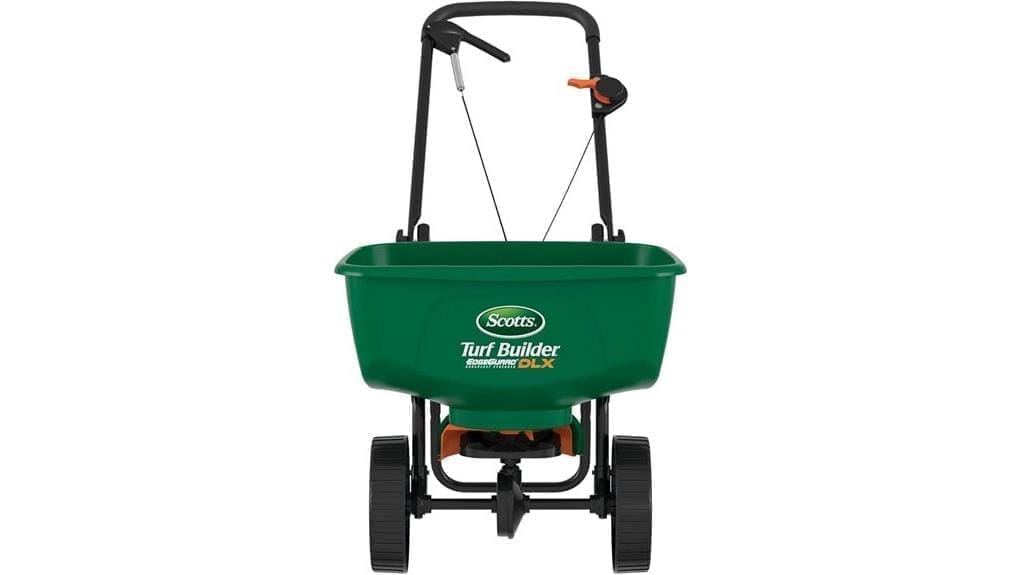

You’ll get reliable, no-fuss broadcast spreading with tight edge control using the Scotts Turf Builder EdgeGuard DLX. It’s pre-calibrated, holds up to about 15,000 sq ft, and the EdgeGuard shield prevents overspill onto drives and beds so you spend less time touch‑ing up. The curved hopper and dual agitator keep granules flowing, while a rate dial matches product settings for predictable coverage. It’s ideal for homeowners who want straightforward results—and the full review explains why.
Some Key Takeaways
- Reliable EdgeGuard prevents right-side overspill, enabling precise runs along driveways and beds.
- Pre-calibrated rate dial and curved hopper with dual agitator ensure steady, predictable granule flow.
- 15,000 sq. ft. capacity and plastic construction suit homeowners but may need more refills for larger yards.
- Lightweight design is easy to use, though pushing on slopes or rough turf can feel tiring.
- Better value and less waste than cheap spreaders; commercial users should consider tow-behind alternatives.
Quick Verdict : Is the EdgeGuard DLX Worth Buying?
Although it depends on your yard size and priorities, the EdgeGuard DLX is worth buying if you want a reliable, no-fuss broadcast spreader that prevents overspill onto driveways and beds. You’ll appreciate edgeguard effectiveness when you mow near borders, saving time on touch-ups and protecting neighbors’ spaces. For most homeowners, performance and simplicity justify the price; a brief cost analysis shows lower waste and fewer repeat treatments versus cheap spreaders. You’ll feel included in a community of practical caretakers who value consistent results. If you want dependable coverage with minimal fuss, this model fits that role. Choosing the right spreader also means matching features to your lawn care needs, such as considering drop spreaders for precision in smaller yards.
What the EdgeGuard DLX Includes and Key Specs
Now that you’ve seen why the EdgeGuard DLX is a practical buy, let’s look at what comes in the box and the specs that matter for everyday use. You get one pre-calibrated unit (Scotts 76232) — no assembly — with a 15,000 sq. ft. capacity spec for typical lawn projects. Item dimensions are 19 x 22 x 22 inches; weight is 10.9 pounds. Material details list the unit in green plastic designed for outdoor use, with a curved hopper and dual-bladed agitator included. Also expect the EdgeGuard side shield, rate control dial, UPC/ASIN info, and manufacturer warranty access. This model is aimed at homeowners who value home yard care and user-friendly features.
How EdgeGuard, Hopper and Flow Control Perform in Real Use
When you push the EdgeGuard DLX across your lawn, the EdgeGuard shield consistently blocks the right-side spread so you can run tight along beds and driveways without overspill, while the curved hopper and dual-bladed agitator keep granules flowing steadily to the spinner to minimize clumping and misses; the rate control dial then lets you match the output to product-specific settings printed on the bag, giving predictable coverage once you’ve dialed in the correct number. In practice, edge distribution stays narrow and consistent, the hopper geometry aids clog prevention, and you’ll notice fewer skips, even with varied granule sizes. Our store also offers related spreader accessories and replacement parts to help you maintain peak performance, including hopper covers and replacement agitators for long-term use with lawn spreaders.
Pros, Cons, and Common User Pain Points
While it delivers dependable, targeted spreading for most lawn jobs, you should know the practical trade-offs: the EdgeGuard DLX gives you tight edge control, steady flow from the curved hopper and agitator, and simple rate dialing, but its plastic construction and 15,000 sq. ft. capacity mean it can flex under heavy loads and require occasional recalibration for different product granule sizes; users also report that pushing on slopes or rough turf can feel tiring compared with wheeled heavy-duty tow-behind models, and the right-side shield—helpful for borders—adds width that can make maneuvering in tight spaces a bit awkward.
You’ll appreciate easy setup and predictable spread patterns, yet expect durability concerns over years of harsh use and occasional calibration issues when switching materials. Maintenance is straightforward; store indoors and check fasteners. If you want community-tested tips, others recommend lighter loads, gentle speeds, and verifying rates with a catch test to feel confident and connected to fellow lawn-care stewards. Many homeowners pair a lawn sweeper with a broadcast spreader to collect debris before seeding or fertilizing, which helps maintain a tidy yard and longer-lasting results for your outdoor spaces.
Who Should Buy This Spreader and Smarter Alternatives to Consider
If you need reliable, targeted spreading for routine lawn care and seasonal ice-melt jobs, the Scotts Turf Builder EdgeGuard DLX is a solid choice—especially if you value easy setup, product-specific rate dialing, and the EdgeGuard shield that keeps granules off driveways and beds. You should buy it if you’re a home gardener who wants consistent coverage without fuss, or a small-property manager needing year-round versatility. If you need higher capacity, powered feed, or wider commercial routes, consider tow-behind or walk-behind professional models from Earthway or Lesco. Commercial landscapers will prefer workhorse units; hobbyists will love the DLX. For homeowners who also aerate regularly, pairing the spreader with a quality lawn aerator can improve fertilizer uptake and overall turf health.
Some Questions Answered
Can the Spreader Be Folded or Stored Upright to Save Space?
Yes — you can store it upright to save space. The spreader doesn’t have a dedicated folding mechanism, but you’ll feel secure standing it vertically against a wall or in a corner with the handle down and hopper supported. For stability, engage the wheels and rest the frame on a flat surface; you can also hang or strap it to a wall hook to prevent tipping. You’ll keep your space organized and accessible.
Are Replacement Parts Like Agitator Blades Available Separately?
Yes — you can get replacement blades for the agitator; Scotts offers parts through customer service and authorized dealers. If OEM parts aren’t available, you’ll find aftermarket options compatible with the hopper’s dual-blade design. You’ll want to match blade length, mounting hole pattern, and material to guarantee consistent feeding. Join user forums or local lawn-care groups to compare sources, installation tips, and trusted aftermarket vendors for reliable performance.
Is the Handle Height Adjustable for Different User Heights?
No — the handle height isn’t adjustable; you won’t find a telescoping handle or adjustable grip on this model. You’ll use the fixed-length handle that’s designed for general comfort and control, so if you’re taller or shorter you might want to try it in-store first. If you need personalized ergonomics, consider aftermarket handle adapters or other spreaders with telescoping handles and adjustable grips to include everyone in your lawn-care routine.
Can It Be Safely Used on Steep or Uneven Terrain?
You can, but exercise caution on steep or uneven terrain. You’ll need to watch for slope traction loss and potential load shifting as the hopper’s weight moves; keep the spreader light, walk slowly, and maintain a low, steady stance. Avoid very steep slopes, turn downhill only when necessary, and stop if you feel instability. Use spot treatments or a specialized spreader for challenging areas so everyone feels safe and included.
Does the Spreader Require Lubrication or Regular Maintenance?
Yes — you’ll want light maintenance. Clean the hopper after use, check and tighten hardware, and lubricate wheels and axle occasionally to assure smooth operation and rust prevention. Inspect and clear the dual-bladed agitator; replace blades if worn — blade replacement keeps feed consistent. Store the unit dry and covered in winter. Doing this simple care keeps you and fellow gardeners sharing reliable, uniform spreading season after season.


